
The dryer duct length code sets a maximum exhaust run of 35 feet, with reductions for every elbow along the way. Most residential codes, including the version Florida builders follow, use this rule to keep lint from collecting in duct runs that are too long or too twisted. If your home’s setup doesn’t match these numbers, you could be looking at slower drying, higher fire risk, or a failed inspection.
I’ve crawled into a lot of Florida attics over the years, and the same mistake shows up again and again: a builder ran flexible duct the shortest visual path, not the shortest legal one, and never accounted for the elbows. That’s how a "code-compliant" home ends up with a duct run that’s actually 10 feet over the limit once you count the bends.
📌 Key Takeaways
- Standard code caps dryer duct runs at 35 feet, minus 2.5 feet per 45-degree elbow and 5 feet per 90-degree elbow.
- Smooth rigid metal duct is required by most codes — flexible foil or vinyl duct is a fire hazard and often not permitted.
- A blocked dryer duct forces the code-max length even lower in practical terms, since lint narrows the usable airflow path.
- Homes in The Villages, Oxford, and Wildwood often need rerouting or a booster fan when the laundry room sits far from an exterior wall.
- Annual cleaning and a professional length check catch code violations before they become fire risks or warranty issues.
Jump to a section:
- Why the Length Code Exists
- What the Code Actually Requires
- Warning Signs Your Duct Run Is Out of Compliance
- DIY Cleanout vs. Professional Service
- Replacement and Rerouting Options
- Local Notes for The Villages, Oxford, and Wildwood
- FAQ
Why the Length Code Exists
Quick Answer: Longer duct runs trap more lint, and lint is the leading fuel source in dryer fires. Code limits exist to keep airflow strong enough to push moist, lint-heavy air completely outside.
A dryer duct isn’t just a pipe — it’s an exhaust duct, meaning it’s designed to carry hot, humid air and fine lint particles out of your home in one continuous push. When a run is too long, air velocity drops, and lint settles inside the duct instead of blowing clear.
According to the U.S. Fire Administration, clothes dryers are involved in thousands of home fires every year, and failure to clean is the most commonly cited factor. Length limits are a preventive measure, not a bureaucratic formality.
The Lint Buildup Connection
Lint accumulates fastest in the last few feet before the exterior termination and at any bend. A duct that’s already near the maximum length has less margin before that buildup becomes a full blockage.
⚠️ Common Mistake: Homeowners assume a shorter-looking duct run is automatically code-compliant. Elbows and vertical rises add hidden length that pushes many runs past the limit.
What the Dryer Duct Length Code Actually Requires
Quick Answer: The International Residential Code, adopted with modifications across Florida, caps total dryer duct length at 35 feet and requires smooth rigid metal duct for the entire run.
The dryer duct length code is built around a simple formula. Start at 35 feet maximum, then subtract length for every fitting that changes direction. Manufacturers sometimes allow longer runs if their installation instructions specify it, but that requires documentation on-site for an inspector.
Maximum Length and Elbow Deductions
Here’s how the standard deduction table generally breaks down under the International Code Council’s residential provisions:
| Fitting Type | Length Deducted from 35-Foot Max |
|---|---|
| 90-degree elbow | 5 feet |
| 45-degree elbow | 2.5 feet |
| Rooftop or high vertical termination | Often reduces allowable run further |
| Manufacturer-rated duct system | May allow longer runs with documentation |
Material and Diameter Rules
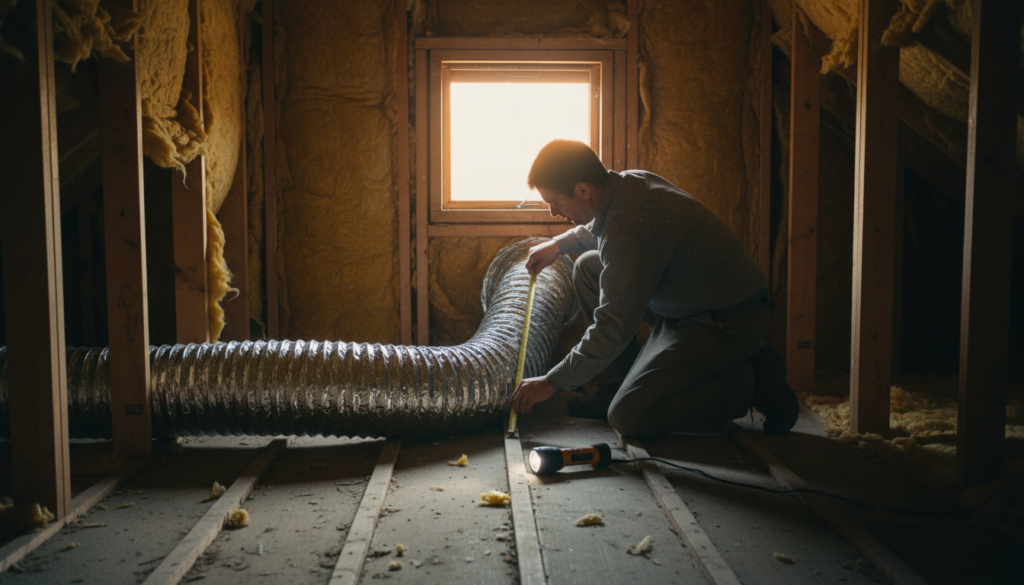
Code requires rigid or semi-rigid metal duct with a smooth interior — corrugated flexible duct snags lint and isn’t allowed for the concealed portion of most installs. Diameter is almost always 4 inches, and duct tape isn’t an approved fastener; screws inside the duct interior are also discouraged because they catch lint.
💡 Expert Insight: As a CSIA Certified Dryer Exhaust Technician, I measure total equivalent length on every job, not just visible distance. That’s the only way to know if a run genuinely meets dryer duct code requirements.
Our dryer vent install service always starts with this measurement, because guessing leads to callbacks.
Warning Signs Your Duct Run Is Out of Compliance
Quick Answer: Longer-than-normal drying times, a hot laundry room, and visible lint at the exterior vent are the clearest signs a duct run is too long, too clogged, or both.
A duct that technically meets length code can still behave like a blocked dryer duct if it hasn’t been cleaned in a year or more. Symptoms overlap, which is why professionals check both length and cleanliness during an inspection.
Blocked or Clogged Dryer Duct Symptoms
Watch for these specific red flags:
- Clothes need two or more cycles to dry completely.
- The dryer’s exterior cabinet feels unusually hot to the touch.
- A burnt or musty smell lingers near the laundry area.
- Lint accumulates visibly around the exterior vent hood.
- The vent flap barely moves or doesn’t open during a cycle.
If you’re noticing these signs, our guide on spotting a dryer vent clog before it becomes a fire hazard walks through each one in more detail.
📊 Data Point: The Consumer Product Safety Commission has repeatedly flagged clogged exhaust ducts as a top contributor to dryer-related home fires, reinforcing why both length and cleanliness matter together.
DIY Cleanout vs. Professional Service
Quick Answer: A homeowner can handle light interior lint trap cleaning, but a full dryer duct clean out and code check requires tools and access most homeowners don’t have.
Cleaning out a dryer duct yourself with a store-bought brush kit can help between professional visits. It won’t, however, tell you whether your total run length or elbow count violates code, and it can’t reach lint packed into a long horizontal or vertical section.
| Task | DIY | Professional |
|---|---|---|
| Lint trap cleaning | Yes, weekly | Not needed |
| Cleaning out dryer duct interior | Limited reach | Full-length rotary brush cleaning |
| Verifying length code compliance | Not possible without tools | Measured and documented |
| Blocked dryer duct clearing | Risky, may damage duct | Safe, complete removal |
| Exterior vent inspection | Visual only | Full airflow and damper test |
When to Call for Professional Cleaning
If it’s been over a year since your last service, or you’ve never had one, it’s time. Our dryer cleaning service checks both airflow and code compliance in the same visit.
✅ Quick Tip: Search "clean dryer duct near me" and confirm the company is CSIA certified — certification means they’re trained specifically on exhaust systems, not general duct cleaning.
Replacement and Rerouting Options
Quick Answer: When a duct run is too long, too bent, or made of the wrong material, replacement or rerouting is usually cheaper long-term than repeated cleaning visits.
Sometimes the fix isn’t cleaning — it’s correcting the installation. A dryer duct installation near you should always start with a length calculation, not just matching the old layout.
Common Replacement Scenarios
Rerouting makes sense when a laundry room sits in the center of a house, far from any exterior wall. We cover the process in our dryer vent rerouting guide, including when a booster fan becomes necessary.
Exterior terminations also wear out. A crushed or rusted vent hood restricts airflow just as much as an over-length run. Our exterior vent replacement service swaps these for code-compliant, damper-equipped hoods.
⚠️ Common Mistake: Replacing a damaged exterior cap without checking the full duct length first. If the run was already near the 35-foot limit, a new cap won’t fix an underlying code violation.
For homes where the laundry room was relocated during a remodel, a dryer vent box installation can shorten the run and bring an old setup back into compliance.
Local Notes for The Villages, Oxford, and Wildwood
Quick Answer: Many homes in The Villages, Oxford, and Wildwood have laundry rooms built mid-house, which often means longer duct runs that need careful length verification.
We see this pattern constantly across central Florida’s fast-growing communities. Slab-on-grade construction common in The Villages often routes duct through the attic in long horizontal stretches, adding hidden length through multiple turns.
Why Local Layouts Matter
In Oxford and Wildwood, where many homes share similar builder floor plans, one property’s duct problem is often repeated street after street. If your neighbor has had a rerouting done, it’s worth having your own home checked too.
Our team handles dryer vent cleaning in The Villages, FL regularly and has documented the length-code issue in dozens of homes across these neighborhoods.
💡 Expert Insight: In my experience servicing The Villages and surrounding areas, roughly one in four homes we inspect has a duct run that exceeds code once elbows are properly counted.
FAQ
What is the maximum dryer duct length allowed by code?
Most residential code allows a maximum of 35 feet of duct, reduced by 5 feet per 90-degree elbow and 2.5 feet per 45-degree elbow. Manufacturer-rated duct systems can sometimes extend this with documented approval.
How do I know if my dryer duct length code compliance is a problem?
Long dry times, a hot laundry room, and lint visible at the exterior vent are common signs. A professional measurement of total equivalent length, including all bends, is the only way to confirm compliance.
Can flexible duct be used to meet dryer duct code requirements?
Generally no — most codes require smooth rigid or semi-rigid metal duct for concealed runs. Flexible foil or vinyl duct traps lint faster and is a known fire hazard.
How often should I schedule a dryer duct clean out?
Once a year is the standard recommendation for most households, though larger families or homes with long duct runs may need service every six to eight months.
What happens if my dryer duct is clogged but still within code length?
A dryer duct clogged with lint behaves like an over-length run because it restricts airflow the same way. Cleaning it restores proper venting even if the physical length is technically compliant.
Is dryer duct repair or full replacement better for an out-of-code run?
Minor issues like a damaged exterior cap usually only need repair, but a fundamentally too-long or improperly routed run typically needs rerouting or replacement to actually meet code.
Where can I find dryer duct replacement near me in central Florida?
Homeowners across Marion, Sumter, and Lake counties, including The Villages, Oxford, and Wildwood, can reach our team through our service areas page for scheduling.
Final Thoughts
The dryer duct length code isn’t a technicality — it’s a practical fire-safety standard built around how far air can carry lint before it starts settling. Whether your issue is a duct run that’s simply too long, too clogged, or built with the wrong material, the fix usually involves the same steps: measure, clean, and correct.
- Check your dryer’s drying times and note any recent changes.
- Inspect the exterior vent hood for lint buildup or a stuck damper.
- Schedule a professional measurement of your total duct length and elbow count.
- Address any code violations through cleaning, rerouting, or replacement.
- Set a recurring annual cleaning reminder going forward.
As a CSIA Certified Dryer Exhaust Technician serving Marion, Sumter, Lake, Citrus, and Alachua counties, we check length code compliance on every visit, not just lint levels. Contact our team today to schedule a full dryer duct inspection and keep your home’s exhaust system safe and code-compliant.

