
Dryer Vent Routing & Code Compliance: The Structural Engineering Guide
A professional dryer vent install service ensures your exhaust system safely removes highly flammable lint, excess moisture, and toxic gases from your home using code-compliant rigid metal ductwork. If you are updating your laundry setup, a poorly routed vent is a ticking time bomb for fire hazards and appliance failure. In this comprehensive guide, we explore why specialized installation is the ultimate solution for a high-performing, safely operating home.
📌 Key Takeaways
Fire Prevention: Proper installation using rigid metal ducting prevents the lint accumulation that causes over 13,000 house fires annually.
Code Compliance: Expert installers adhere to the International Residential Code (IRC), ensuring your vent run does not exceed maximum allowable lengths.
Appliance Longevity: Optimized airflow reduces backpressure, saving your dryer’s blower motor and heating element from premature burnout.
Material Matters: Professionals ban the use of flimsy foil hoses and duct-penetrating screws, which are the leading causes of hidden blockages.
Energy Savings: A direct, properly sealed vent path cuts drying time in half, saving households up to $240 a year in wasted utilities.
Table of Contents
The Critical Importance of Professional Installation
The Science of Airflow and System Backpressure
5 Warning Signs You Need a New Dryer Vent
Code-Compliant Materials We Use
DIY vs. Professional Installation: The Hidden Risks
Frequently Asked Questions (FAQ)
Conclusion & Next Steps
The Critical Importance of Professional Installation
Quick Answer: Professional installation guarantees that your exhaust path uses the shortest possible route and fire-rated materials, eliminating the hidden blockages that cause catastrophic home fires.
A standard dryer vent install service is not just a luxury upgrade; it is a vital necessity for modern homeowners. Many assume that connecting a dryer is a simple plug-and-play operation. However, the exhaust system is a critical piece of your home’s infrastructure.
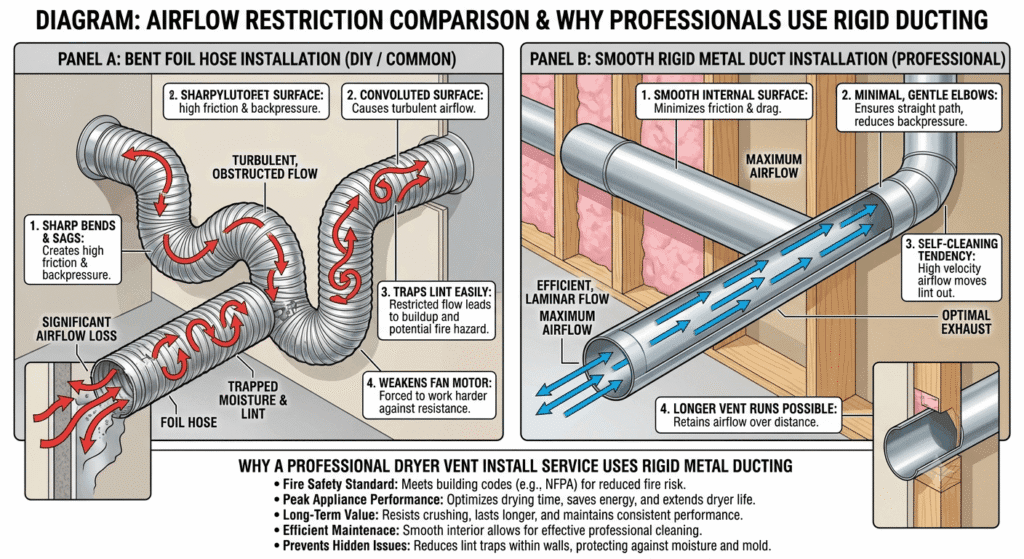
When a vent is installed with too many bends or uses improper materials like “foil” slinky hoses, lint traps easily. Over time, this creates a dense blockage. The blockage forces extreme heat back into the dryer cabinet, potentially igniting the highly flammable lint. Professional services ensure that every joint is sealed airtight and every turn is optimized for maximum exhaust velocity.
📊 Data Point: According to the National Fire Protection Association (NFPA), nearly 16,000 home structure fires are caused by clothes dryers every year. The leading cause (34%) is a failure to clean or properly install the venting system.
The Science of Airflow and System Backpressure
Quick Answer: Exhaust systems rely on static pressure. If a pipe is too long or has too many sharp turns, backpressure builds up, trapping moisture and heat inside the dryer drum.
At Complete Dryer Vent, we specialize exclusively in the niche science of appliance ventilation. Unlike a general handyman, a dedicated dryer vent install service team understands the exact physics of backpressure.
If a vent pipe is too long or has too many 90-degree elbows, the dryer’s blower motor has to work twice as hard. It struggles to push moist air outside. This resistance creates “backpressure,” which keeps heavy moisture circulating inside the drum.
This isn’t just about drying clothes faster; it is about preventing severe mechanical failure. We use specialized digital anemometers to measure airflow in cubic feet per minute (CFM). This testing ensures your system performs exactly as the manufacturer intended.
5 Warning Signs You Need a New Dryer Vent
Quick Answer: Look out for extended drying times, a scorching hot dryer cabinet, musty odors, visible lint behind the machine, and exterior vent flaps that fail to open during operation.
How do you know if it is time to call a professional dryer vent install service? Before a complete system failure occurs, watch for these five critical red flags:
1. Extended Drying Times
If your standard load of towels or jeans takes two or three cycles to dry, your vent is severely restricted. The moisture has nowhere to go.
2. Excessive Appliance Heat
Touch the top of your dryer during a heavy cycle. If the metal feels burning hot to the touch, the system is retaining dangerous levels of heat.
3. Musty Smells in the Laundry Room
Moisture that isn’t escaping the house condenses inside the ductwork. This leads to toxic black mold growth inside your walls and a persistent musty odor.
4. Visible Debris Accumulation
If you see thick lint accumulating on the wall behind the dryer or scattering across the floor, your current duct connections are leaking.
5. Exterior Flap Failure
Walk outside while the dryer is running. If the exterior vent hood flap stays closed or barely flutters, the airflow is drastically compromised.
Financial and Safety Benefits of Professional Installation
Quick Answer: Investing in a proper installation yields immediate returns through lower energy bills, a drastically extended appliance lifespan, and safely managed indoor air quality.
Choosing a specialized dryer vent install service ensures your system meets local building codes and manufacturer specifications. The benefits extend far beyond basic fire safety.
Improved Energy Efficiency
When hot air flows freely to the exterior, your dryer runs for significantly less time. This simple efficiency can save the average household upwards of $20 per month on electricity or gas bills. Over a single year, the installation service practically pays for itself through monthly utility savings.
Extended Appliance Lifespan
Modern dryers are expensive, often costing between $800 and $1,500. Forcing a motor to work constantly against a poorly routed vent leads to premature part failure. By reducing backpressure, a proper installation protects your heating element, thermal fuses, and drive belts from early burnout.
Enhanced Indoor Air Quality
Improperly sealed vents are a massive liability. They can leak carbon monoxide (in the case of gas dryers) or pump excessive moisture directly into your laundry room. Professional installation guarantees a gastight seal from the back of the appliance to the exterior wall cap.
⚠️ Common Mistake: Never vent a dryer into an attic, crawlspace, or garage. Venting indoors pumps gallons of water into your home’s framing per week, causing massive wood rot and structural mold.
Our Step-by-Step Installation Process
Quick Answer: Our installation process includes site mapping, IRC code compliance checks, custom rigid duct cutting, specialized foil-tape sealing, and pest-proof exterior cap installation.
At Complete Dryer Vent, our standard dryer vent install service follows a rigorous, engineering-grade protocol. This ensures 100% compliance with national safety standards.
Step 1: Site Assessment & Path Mapping
We begin by determining the shortest, most direct path to the exterior of your home. Every foot of ducting and every 90-degree turn adds friction and resistance. We architect the path of least resistance.
Step 2: Code Compliance Verification
We ensure the total vent length does not exceed the maximum allowed by the International Residential Code (IRC section M1502). Typically, this maximum is 35 feet. We calculate strict deductions for every elbow joint used in the run.
Step 3: Rigid Ducting Installation
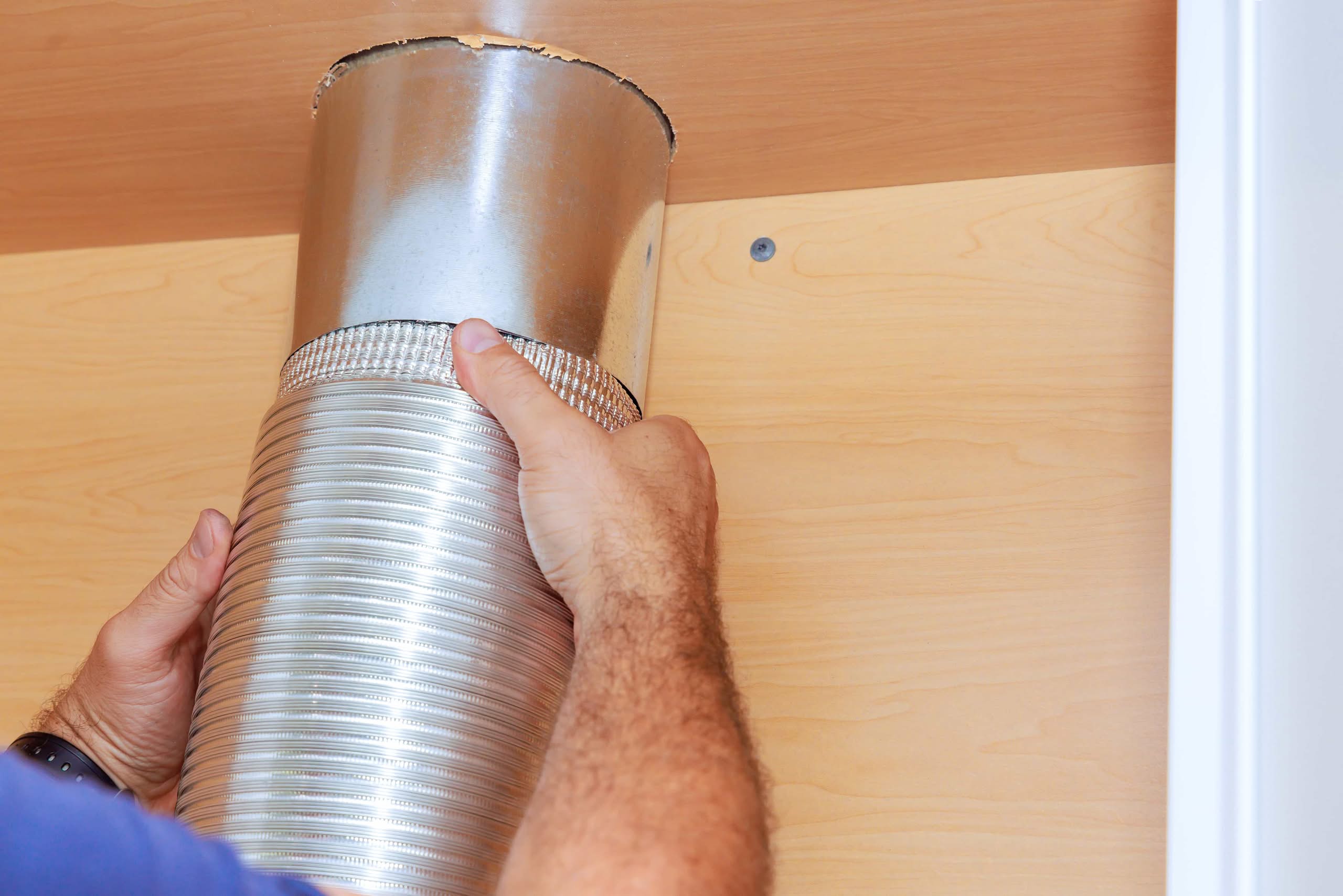
We strip out and replace highly flammable plastic or flexible foil pipes. We install heavy-gauge rigid aluminum or galvanized steel ducting. This is the only material that truly resists fire and allows for smooth, frictionless airflow.
Step 4: Joint Sealing & Support
We never use standard cloth duct tape, which degrades rapidly under heat. Instead, we seal every connection with high-heat, HVAC-grade foil tape. We also install professional-grade metal hangers to prevent the duct from sagging over the years.
Step 5: Exterior Vent Cover Placement
Finally, we install pest-proof, high-airflow wall caps on the exterior of your home. These specialized covers prevent birds and rodents from nesting in your warm vent while allowing lint to exit completely unobstructed.
Code-Compliant Materials We Use
Quick Answer: We strictly use rigid metal ducting, semi-rigid transition hoses, high-heat foil tape, and a strict “no-screws” policy to prevent lint snags.
The overall quality of a dryer vent install service is only as good as the materials utilized. We refuse to cut corners, prioritizing the following components:
Rigid Metal Ducting: The absolute gold standard for fire safety. Its smooth interior walls prevent wet lint from snagging and accumulating.
Semi-Rigid Transitions: We use these solely for the short, 8-foot maximum connection between the back of the dryer and the wall. This allows for slight appliance movement without crushing the pipe.
The “No-Screws” Policy: We strictly prohibit using sheet metal screws to connect duct joints. Sharp screw points penetrate the duct interior, immediately catching lint and creating massive “plugs.”
HVAC Foil Tape: Unlike traditional cloth duct tape, aluminum foil tape does not dry out, off-gas, or peel away when exposed to the extreme heat of the dryer exhaust.
💡 Expert Insight: In our years of field experience, over 80% of the severe clogs we clear were originally caused by a single rogue screw penetrating the duct wall, acting as a net for passing lint.
DIY vs. Professional Installation: The Hidden Risks
Quick Answer: DIY installations frequently violate building codes, utilize non-fire-rated materials, and lack the airtight sealing required to prevent hidden moisture damage inside wall cavities.
While many homeowners enjoy tackling weekend DIY projects, a proper dryer vent install service involves complex structural routing through walls, attics, or tight crawlspaces.
| Feature | DIY Installation | Professional Service |
| Material Quality | Often uses flimsy, crushable foil | Industrial-grade rigid metal |
| Code Compliance | Frequently violates IRC length rules | Strictly calculated and followed |
| Specialized Tools | Standard household hand tools | Anemometers & digital borescopes |
| Fire Safety | High risk of hidden air gaps | Guaranteed airtight foil seals |
| Warranty & Liability | None (Homeowner assumes risk) | Professional guarantee and insured |
Mistakes in DIY plumbing or ventilation projects are often hidden behind drywall. A small, unnoticed exhaust leak in an attic can quickly lead to massive mold issues that cost thousands of dollars to remediate. Professional technicians utilize specialized tools to guarantee the line is clear, perfectly connected, and sealed for life.
Frequently Asked Question
How much does a professional dryer vent install service cost?
Costs vary based on the required length of the run, the materials needed, and the accessibility of the exit point (e.g., a steep roof versus a ground-level side wall). Most residential installations range between $200 and $500.
How long does a complete installation take?
Most professional residential installations are completed within 2 to 4 hours. However, complex routing through multi-story homes or dense crawlspaces may take slightly longer.
What is the best material for a dryer vent?
The International Residential Code dictates that the best material is rigid, smooth-walled aluminum or galvanized steel. It provides the least airflow resistance and is completely fireproof.
Why can’t I use screws to attach my dryer vent pipes?
Screws penetrate the inner wall of the duct pipe. These sharp points act like hooks, catching passing lint fibers. Within months, a single screw can cause a complete, hazardous blockage inside the wall.
Do you provide a dryer vent install service for commercial laundromats?
Yes, our expert dryer vent install service scales for multi-unit housing, hotels, salons, and commercial laundromat facilities that require heavy-duty, high-capacity venting solutions.
Conclusion & Next Steps
Don’t gamble with your home’s structural safety or your family’s health. A professional dryer vent install service is the most cost-effective and reliable way to ensure your appliance runs safely and efficiently for years to come. By replacing dangerous foil hoses with code-compliant rigid ductwork, you eliminate fire hazards, lower your energy bills, and protect your expensive appliances.
By choosing Complete Dryer Vent, you are partnering with specialized experts dedicated to technical excellence and absolute home safety.
Ready to upgrade your home’s safety? Take action today:
Check the material of the hose behind your dryer (replace it if it is plastic or thin foil).
Assess how long your clothes take to dry during a normal cycle.
Contact our team to schedule an on-site airflow diagnostic and routing assessment.

